Readability scores: check the formula and its limits
Updated October 12, 2026 · 5 min read · 6 sections

A readability score can change after a sentence split even when the argument stays exactly the same. I treat that change as a clue about surface difficulty, then read the revision to decide whether it helps. Four decimal places do not turn an approximate syllable count into a precise assessment. Before comparing numbers, check the language, the sample and the counts used in the formula.
Start with four counted inputs
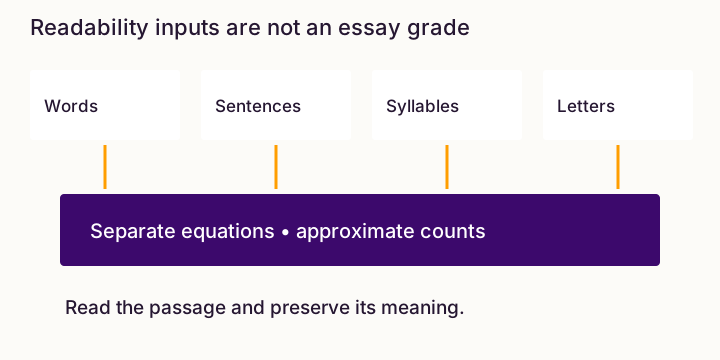
For Flesch Reading Ease and Flesch–Kincaid, you need words, sentences and syllables. Gunning Fog also uses a count of complex words. Coleman–Liau instead uses letters alongside word and sentence totals. The essay checker displays these inputs so you can inspect a result instead of accepting a hidden score.
The syllable count here comes from English letter patterns with a small exception list. It is an approximation, particularly for names, uncommon terms and words whose spelling does not closely match pronunciation. A numeric token counts as a word and receives the declared one-syllable fallback. Do not interpret that as a spoken reading of the number.
Sentence boundaries are another source of variation. An abbreviation can resemble a sentence ending, and an unfinished final clause may still count as a sentence. When comparing two tools, check these counts first. A disagreement in syllables or sentence boundaries can explain a difference without implying that either tool measured writing quality.
A reproducible set of formula inputs
Take a hypothetical English passage with 120 words, 6 sentences, 180 estimated syllables, 600 letters and 24 words estimated to contain at least three syllables. These are control inputs, not statistics from a real student. Average sentence length is 120 ÷ 6 = 20 words. Average syllables per word is 180 ÷ 120 = 1.5.
Flesch Reading Ease is 206.835 − 1.015 × 20 − 84.6 × 1.5 = 59.635. The tool displays 59.6 when using one decimal place. Flesch–Kincaid is 0.39 × 20 + 11.8 × 1.5 − 15.59 = 9.91, displayed as 9.9. The Microsoft documentation describes both formulas. The grade-level output is a reading estimate, not an academic mark.
For the stated Fog approximation, complex words are 24 ÷ 120 × 100 = 20 percent. The result is 0.4 × (20 + 20) = 16. More elaborate Fog implementations can exclude particular words or handle syllables differently. This tool does not apply every such exception, and names the result an approximation.
| Measure | Intermediate values | Raw result |
|---|---|---|
| Flesch Reading Ease | 20 words/sentence; 1.5 syllables/word | 59.635 |
| Flesch–Kincaid | 0.39 × 20 + 11.8 × 1.5 − 15.59 | 9.91 |
| Gunning Fog approximation | 20% estimated complex words; average 20 | 16 |
| Coleman–Liau | 500 letters/100 words; 5 sentences/100 words | 12.12 |
Coleman–Liau needs letters rather than characters
Letters per hundred words are 600 ÷ 120 × 100 = 500. Sentences per hundred words are 6 ÷ 120 × 100 = 5. Coleman–Liau is 0.0588 × 500 − 0.296 × 5 − 15.8 = 12.12. Counting punctuation or spaces as letters would change the result for the wrong reason.
The checker’s character total is separate. It measures UTF-16 positions for selection and export, and does not replace the letter total in the formula. This distinction also matters when the draft contains emoji or numbers. A visible character and one JavaScript character position are not always the same thing.
Coleman–Liau does not need a syllable dictionary, but that does not make it a complete judgement of reading difficulty. It still depends on the word and sentence convention, and it cannot observe whether an argument uses familiar concepts, explains necessary terminology or presents evidence clearly.
Raw values can fall outside a familiar range
Flesch Reading Ease is often discussed on a zero-to-one-hundred scale, but the equation itself can produce negative values or values above one hundred. The checker keeps the raw result. Clipping a negative result to zero would hide a change between two passages that both fall below zero.
The textstat project documentation also discusses values outside that familiar range and language-specific readability methods. Its implementation is not claimed to be identical to this checker’s local heuristics. The useful lesson is to distinguish the formula’s arithmetic from a simplified label attached to its result.
A very short sample is unstable because one added word or sentence has a large effect on the averages. The tool shows a short-sample note below one hundred words. That display threshold is a caution for this interface, not a guarantee that every longer passage gives a reliable estimate.
An English formula is not a universal language test
Choose the language of the draft honestly. German compounds, French sentence conventions and Portuguese spelling cannot be made equivalent to English by changing an interface label. The checker suppresses these four estimates for the other five selected languages. Counts and paragraph maps remain available.
Even within English, subject matter and audience matter. A necessary technical term can have several syllables and still be familiar to the intended reader. Replacing it with a vague short word may lower the formula while making the explanation less useful. A specialist essay needs definitions and sound reasoning, not a target syllable count.
For this reason, I do not combine the four outputs into a percentage or use them to assign a writing grade. They offer different views of surface complexity, with shared limitations. A single composite number would make those limitations harder to see.
Compare the revision and the reasoning together
Keep a baseline, revise one passage, and check the draft again. If average sentence length drops, identify the sentences that changed. A split can clarify a complex chain of conditions; it can also detach a qualification from the claim it belongs to. Read the original and revised versions aloud if that helps you notice the connection.
A useful revision preserves meaning, makes relationships explicit and suits the assignment’s audience. The formula can support that judgement, but it cannot perform it. Record important versions in your own document; the tab comparison contains only aggregate statistics and disappears with the page.
FAQ
Is the Flesch–Kincaid result my essay grade?
No. It is an approximate reading-level estimate from surface features, not an assessment of the essay’s reasoning or evidence.
Why can Flesch be negative?
The raw equation can produce values outside zero to one hundred. This tool does not clip those values.
Why are results different from another checker?
Word, sentence and syllable conventions can differ. Compare the input counts and the language assumptions first.