Essay checker with clear writing statistics
Before submitting, check word limits, repeated words and sentence length with the essay checker.
Paste your essay, choose its language, then select Check essay.
Fictional English example essay.
Paste your draft here. Blank lines separate paragraphs. Maximum 100,000 characters.
Assignment limits and keywords
Readability and passive-voice patterns are available for English text.
Leave the word limits blank if the assignment has none.
Separate up to 20 words or phrases with commas. Maximum 80 characters per phrase.
UTF-8 plain text only, up to 400 KB. Files are read in this browser.
Ctrl/⌘ + Enter checks. Ctrl/⌘ + Shift + C copies the report.
Paste a draft and check it to see sentence and paragraph maps.
Writing statistics
Local suggestions to review
Adjacent repeated words on the same line can be intentional. Read the phrase before removing one. This is a limited pattern check.
Possible English passive sentences
Read these sentences in context: adjectives can resemble passive forms.
Approximate English readability
English estimates use approximate syllable counts. Reading difficulty is not an essay grade.
Counts used in the formulas
Compare a revision
The comparison keeps statistics only. Read both versions to judge the revision.
Words in each paragraph
Choose paragraph roles yourself. Editing the draft clears these labels.
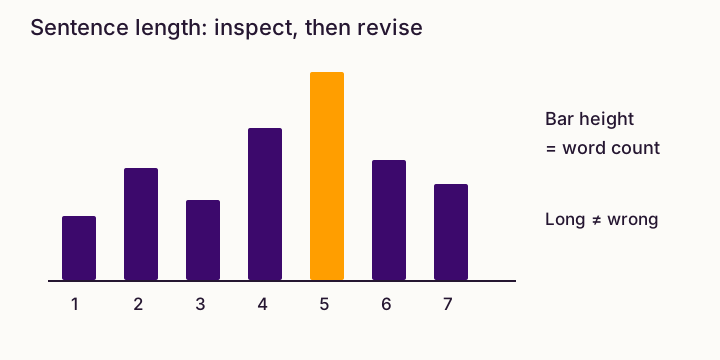
Words in each sentence
Each bar shows a word count; tap a bar to select that passage.
Words in each sentence
Transition words found
Check that each connector expresses the relationship you mean.
Local structure and readability checks; not full proofreading or an essay grade.
Draft history in this tab
Up to five drafts in page memory only. Closing or reloading the tab clears them; no browser storage or account.
Essay checker: start with the assignment, then the draft
Before I polish a sentence, I use the essay checker to compare the draft with the assignment. The essay checker makes that first revision pass easier: enter a word range if you have one, paste the draft, and choose its text language. The counts and maps show where the writing becomes uneven. Keep the prompt beside the draft so each change serves the answer you need to give.
Use Assignment limits and keywords to enter terms from the prompt, separated by commas. The checker finds whole words or phrases without distinguishing case and lets you select each occurrence. A missing term can remind you to revisit the task; a mention alone does not show that you explained it. The result first lists adjacent repeated words and sentences above thirty words, with buttons to jump to the first passage. The English reading meter describes Flesch values of 80 or higher as easy, 60–79.9 as standard, 30–59.9 as demanding and below 30 as very demanding. These bands describe surface reading difficulty, not the strength of the essay. The number stays raw even if the visual meter ends at zero or one hundred. Punctuation in a keyword is kept, so “C++” is not treated as “C”.
The example in the editor is a fictional English school-garden proposal. Its repeated word is deliberate, so you can try a suggestion without risking your own work. Replace the example before drawing conclusions about your essay. Blank lines separate paragraphs; a single line break stays within the same paragraph. Import TXT reads a UTF-8 plain-text file locally, with a file limit of 400 KB and a text limit of 100,000 characters.
This is a browser-only writing review. It does not send your essay to a grammar service, assign a school grade, search for copied passages or decide whether AI wrote the text. Those are different tasks with different evidence. A report without repeated-word candidates means only that this particular pattern found none.
What the counts actually count
Words are sequences of Unicode letters or numbers. Internal apostrophes and hyphens stay inside a word, so “don’t” and “well-chosen” each count once. Decimal numbers and numeric groups such as “2.5” and “1,000” also count once. Punctuation on its own does not count. This is a declared counting convention; an institution or word processor can use another one near symbols, references or hyphenation.
Sentences use the browser’s sentence segmenter where available, with a simpler punctuation fallback and a small abbreviation adjustment. A final fragment without punctuation is included. Abbreviations, quotations, headings and unusual punctuation can still affect the boundary. Select a sentence from the list to inspect the original span instead of trusting a total that conflicts with the text.
The letters count includes letters, not spaces, digits or punctuation. Characters use JavaScript’s UTF-16 length, so some emoji occupy two character positions. Distinct word forms compare lowercased tokens; they do not combine related words through stemming. These counts describe the text under this implementation, not the number of ideas or the sophistication of the vocabulary.
| Input | Result | What the rule means |
|---|---|---|
| One two three. | 3 words; 1 sentence | Final punctuation is not a word. |
| One ends. Last unfinished | 4 words; 2 sentences | The trailing fragment is retained. |
| café über mañana ação | 4 words; 18 letters | Unicode letters are retained. |
| The the cat sat. | 4 words; 1 repeat candidate | The candidate requires your review. |
| word, word | 2 words; no repeat candidate | Punctuation interrupts this repeat pattern. |
| Two words, with maximum 1 | 1 word above the maximum | Range checks use the entered bounds. |
Read the diagrams as maps of length
The sentence diagram gives each sentence a bar whose height is its word count. Alternating colours help distinguish neighbouring bars. They do not represent good and bad writing. A sentence above thirty words receives a review note because it can be worth checking its structure; thirty is a display threshold, not a grammar rule or a required maximum.
The paragraph diagram uses the same idea for paragraphs. A very short paragraph can be a deliberate transition; a long one may develop a connected argument. I compare the shape of a paragraph with its job before splitting it. Assign Introduction, Body or Conclusion yourself if that helps the review. The checker never guesses that the first paragraph contains a thesis or that the last one is a successful conclusion.
Both diagrams show up to sixty items to keep the bars legible. The lists offer more items in batches, and the sentence CSV includes every sentence. Selecting a bar or list item highlights its original text in the editor. If you edit the draft or its settings, the old results disappear until you check again. A fresh result should always describe the draft you are reading.
English readability estimates, with the inputs visible
The four readability formulas are offered only when you select English. Word counts, paragraph maps, repeated-word candidates and the selected language’s connector list remain available for German, Spanish, French, Italian and Portuguese. The text language is your choice, not a language-detection verdict. Selecting English for a non-English draft does not make the estimates valid.
Flesch Reading Ease uses average sentence length and estimated syllables per word. Flesch–Kincaid estimates a reading grade level, which is a text-difficulty estimate rather than the grade an essay deserves. The Microsoft readability documentation describes those formulas and their language dependence. Gunning Fog here uses words estimated to have three or more syllables, without every linguistic exception of a more elaborate implementation. Coleman–Liau uses letters per hundred words and sentences per hundred words.
The syllable counter is a local heuristic, not a pronunciation dictionary. Names, specialised terms and silent letters can change its accuracy. Raw formula values remain raw; a negative Flesch result is not silently raised to zero. Short samples receive an instability note. Read the readability-score explanation before treating a small change as a meaningful improvement.
Suggestions need a sentence around them
Adjacent repeated words on the same line create a candidate such as “the the”. Some repetitions are valid, including “that that” in a suitable sentence. Select, ignore or remove the candidate after reading it. Remove all affects only the currently shown repeated-word candidates, and Undo restores that removal. Every removal recalculates the statistics, so the report does not keep the old word count. Ignored repetitions stay dismissed when you check the same draft or remove another repetition; editing the text or settings starts a fresh review.
For English, a be-verb followed closely by a likely participle creates a possible passive-pattern candidate. That pattern can also catch an adjective or miss a real passive construction. The checker reports sentences containing a pattern and gives no percentage target. Passive voice can be appropriate when the recipient or process matters more than the actor.
Transition matches are literal whole-word or phrase matches from a limited list in your selected language. “However” can express contrast, but finding it does not prove that two ideas contrast logically. I read the neighbouring claims first, then choose a connector. The transition-word guide shows how to make that decision without decorating every sentence.
Compare a revision without rewarding a score
Keep current statistics as baseline before editing. The comparison keeps aggregate counts, not another hidden copy of the essay. Check the revised text and compare word count, sentence count, paragraph count, average sentence length and Flesch where available. A shorter sentence can be clearer, but removing a necessary qualification can make the argument worse even as a formula improves.
Draft history is separate: Remember this draft stores up to five explicitly chosen drafts in the current page’s memory. Nothing is saved automatically, and reloading or closing the tab clears that history. Clear draft empties the editor; Clear tab history and Clear baseline remove those separate items. Keep important work in your own document before leaving the page.
Copy report and Download report TXT exclude the full draft unless you tick Include draft text. Download sentence CSV necessarily includes the actual sentence text with counts and UTF-16 start positions. CSV cells beginning with spreadsheet formula characters receive an apostrophe prefix for safe opening; start positions still refer to the original text. Clipboard denial opens selectable report text. Print statistics provides a simpler paper view. For a paragraph-by-paragraph revision routine, read essay structure and compare every suggested change with the assignment.
Guides
 Essay structure: give every paragraph a clear jobGive each paragraph a job and connect the evidence to your answer.5 min read
 Readability scores: check the formula and its limitsFollow the counted inputs and a worked example before comparing scores.5 min read
 Transition words: show the relationship between ideasChoose the relationship first, then the connector that expresses it.5 min read
FAQ
Does this check every grammar mistake?
No. It checks a small set of local patterns and exposes writing statistics. No repeated-word candidates does not mean the essay is grammatically correct.
Does the checker grade my essay?
No. Readability formulas estimate aspects of text difficulty, not argument quality, evidence or an assessment grade.
Can I check text in another language?
Choose German, Spanish, French, Italian or Portuguese for counts, maps and limited native connector matches. The four readability estimates and passive-pattern candidates are English-only.
Why does another tool show a different word count?
Word boundaries and sentence rules can differ around hyphens, numbers, symbols and abbreviations. Follow the convention required for the assignment.
Where are my drafts stored?
Only explicitly remembered drafts stay in this page’s memory. The tool uses no browser storage and uploads no essay; reloading the page clears the remembered drafts.