Transition words: show the relationship between ideas
Updated October 12, 2026 · 5 min read · 6 sections

“Therefore” makes a claim about the relationship between two ideas. If the second idea does not follow from the first, the word makes the writing less accurate, however fluent it sounds. I choose a transition after deciding what relationship the reader needs to see. That is more useful than adding a connector wherever a sentence feels abrupt.
Name the relationship before choosing the phrase
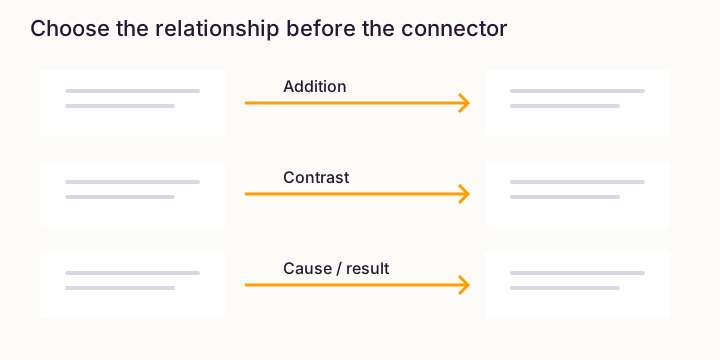
Two sentences can add compatible evidence, contrast positions, explain a cause, give an example or place steps in an order. Those are different relationships. Read both sentences without their opening connector and describe the connection in ordinary language. If you cannot do that, revise the claims or add the missing explanation first.
For a hypothetical garden proposal, “students compare two planted areas” and “the routine needs maintenance” are not simply two interchangeable benefits. The second introduces a practical condition or constraint. “However” may help signal that turn, but the paragraph still needs to explain how maintenance affects the proposal.
The essay checker groups literal matches by possible relationship. It does not determine the actual logic of the passage. The word “since” can refer to time or cause, and many ordinary words perform several functions. A limited connector list cannot capture every meaningful transition.
| Relationship | Possible phrases | Check before using |
|---|---|---|
| Addition | also; furthermore; in addition | Does the new point extend the same line of thought? |
| Contrast | however; whereas; on the other hand | Are the ideas meaningfully different? |
| Cause or result | because; therefore; as a result | Does the evidence support the causal claim? |
| Example | for example; for instance; such as | Does the example actually illustrate the claim? |
| Sequence | first; next; finally | Is the order relevant to the explanation? |
| Closing judgement | overall; to sum up | Does the judgement follow from the preceding discussion? |
An example supports a general point through explanation
Suppose a paragraph claims that the proposed activity should produce observations students can compare. “For example” can introduce two marked growing areas with a recorded difference. The detail becomes useful when the paragraph explains what is measured and why the comparison addresses the learning aim.
An unrelated anecdote does not become evidence just because it follows “for example”. Check the general claim first, then ask whether the example belongs to that category. If it illustrates only part of the claim, narrow the wording or explain the limitation. This matters especially when a broad conclusion rests on a single hypothetical case.
Do not keep stacking examples without developing them. One well-explained example may do more work than several named briefly. In the sentence diagram, a long example sentence can prompt you to separate the description from the explanation, while keeping their relationship visible.
Cause words require stronger reasoning than sequence words
“The class recorded growth. Therefore, the garden improved learning.” The second statement does not automatically follow from the first. Recording growth shows that an activity occurred; it does not by itself establish a learning outcome. A causal connector should not conceal the missing evidence.
A more limited hypothetical statement might say that recording growth supplies observations for a comparison. That connects an action with a directly described output. If you want to make a broader claim, provide evidence suited to that claim and discuss the relevant alternatives. Sequence alone does not establish cause.
Review “therefore”, “consequently” and “as a result” with this question: what exactly follows, and under what assumptions? Sometimes “next” is more accurate because the text is describing order rather than proof. Sometimes no connector is needed once the sentence states the relationship clearly.
Contrast should have a shared point of comparison
A contrast is easier to follow when the reader knows what is being compared. “The activity supports observation; however, maintenance requires a routine” sets a benefit against a practical condition. Explain why both belong in the decision about the proposed trial. Without that shared decision, the turn can feel like a new topic.
“Whereas” usually works inside a sentence that directly compares two clauses. “On the other hand” often signals another side of a consideration. Their punctuation and grammatical behaviour differ, so do not replace them mechanically. The local checker recognises phrases; it does not offer a complete punctuation correction service.
Too many contrast words can also exaggerate disagreement. If the second sentence adds a compatible detail rather than a limitation, “also” or a direct sentence may be enough. The aim is accurate guidance for the reader, not a visible transition in every line.
A transition can be carried by the words of the ideas
Repeated key terms, a clear pronoun reference or a sentence that picks up the previous point can create continuity without an obvious connector. The Purdue OWL paragraph guidance discusses coherence alongside unity and development. I use that principle to check connections across sentences rather than simply count transition words.
If one paragraph ends with the need for a maintenance routine, the next can begin by describing that routine. The repeated idea gives the reader a stable connection. A vague pronoun such as “this” may weaken it if several earlier ideas could be the referent. Name the relevant activity or requirement when needed.
An essay with few listed connector matches can still read clearly. Conversely, an essay full of “moreover” and “therefore” can contain logical gaps. The checker shows literal matches as candidates to inspect, with no completeness score and no target percentage.
Use the selected language’s patterns in context
The tool has separate connector lists for English, German, Spanish, French, Italian and Portuguese. A phrase is matched as a complete word sequence, and a listed phrase is not matched across a punctuation mark or line break. Those boundaries prevent some obvious false matches, but they do not resolve meaning.
Equivalent relationships do not require word-for-word translation. A natural phrase in one language can be too formal or grammatically awkward in another sentence. Choose the text language, read each match in its context and consult a suitable language reference when you need a punctuation or usage decision.
For a final revision pass, underline the claims joined by each connector. Describe their relationship, check the evidence and remove any word that promises more than the sentence establishes. Then recheck the draft so the maps and report describe the revised wording. Keep the final text in your own document, beyond the checker’s temporary tab memory.
FAQ
Do more transitions make an essay better?
Not automatically. The words must express a relationship supported by the actual claims. Clear continuity can also come from precise wording.
Does a match prove that the transition is correct?
No. Matches are literal candidates from a limited language-specific list. Read the surrounding sentences to judge meaning.
Does the tool correct transition punctuation?
No. It does not provide a complete grammar or punctuation check. Use a suitable usage reference for the construction.